Insanity Is Doing Something Over and Over Again and Expecting a Different Result
30 September 2018
Einstein'due south had a lot of witty and profound sayings, but "The definition of insanity is doing the same matter over and once more and expecting a different event" is not one of them. And yet, these words had ofttimes been misattributed to him. It is not exactly articulate who came upward with the phrase, but it is a fact that a lot of people got convinced that originated behind the famous mustache of Einstein.
He was i of the giants of science in the 20th century, (Einstein, not the 'stache) which ways that the phrase has the sound, the ring of something smart. It sounds like something a physics genius might say. The phrase sounds sciencey.
And it had me believing it. Einstein, Meinstein or whoever said it, I subscribed to it. Until my work experience proved it otherwise.
Dorsum when I worked for Twitter, I was running A/B tests. A properly conducted A/B test is one of the closest things you become to science when building a product. Information technology lets yous sift the dissonance and luck out so yous tin can make it at a piece of knowledge. If I change the product from A to B, I volition become Ten% of my customers amend by Y% with statistical significance. That'south the type of judgement yous can confidently claim and bet a lot of money on after an A/B exam.
And nevertheless, A/B tests lack one crucial holding of science. They are not reproducible. If you lot run an A/B examination today, and run the same A/B test half dozen months from now, you might go a different result. Allowing for a different effect is emphatically non insanity. I get it, running the same experiment is probable to result in the same effect. But likely ain't sure.
I saw the same experiment become run twice, the two runs being about a year apart. The results were dissimilar. The first fourth dimension around, the experiment didn't show any improvement. And yet, one-half a year afterwards, it did work. The circumstances had changed. What we were trying to test worked better, even though the thought was the same. One yr later, information technology showed positive improvement. It was greenish.
Same idea. Different upshot. This is counterintuitive AF. Information technology was surprising after the fact, but even harder to imagine a priori.
Because we tend to overgeneralize from limited experiences and discard ideas that failed one time before. One time an idea has been tried unsuccessfully, we tend to requite it a blackness stamp in the passport and ban it from entering our heads once more. Nosotros want knowledge that we can trust, and information technology sometimes takes a single foul for usa to discredit an idea. One strike. Out.
Unscientific. Because scientific discipline is all near reproducibility. The definition of science is doing the same thing over and over and knowing that you'll go the same result. You can show scientifically that if yous drop an apple tree, in the absence of interference from other forces, it will autumn down. It would be incredibly stupid and yeah… insane to believe that the apple may not fall down. It volition be not-scientific, which ways that information technology is non the style the universe we live in works.
In our universe, gravity force ever tries to pull objects down. And science is the way of determining the rules of the universe. But there are limits to science even in a deterministic system.
For example, take magnets. It is reasonable to expect that the Northward Pole of a compass volition always be pointing at the North Pole of the Globe. It has always been pointing the same way. People accept used it to navigate around the globe, for centuries, even millennia. And yet, information technology might flip effectually. It hasn't always been that way. The magnetic field of Earth has reversed its management multiple times, at random intervals
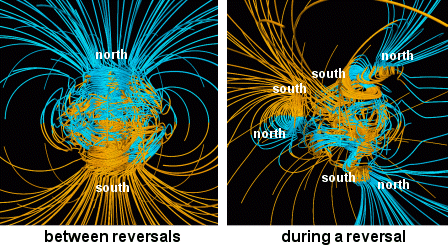
The magnetic reversal of the poles is due to existence part of a chaotic dynamic organisation. Molten metals and whatnot are spinning and twirling and splashing and splashing inside the Globe's core. If they spin mostly in circles, their electric accuse generates a powerful magnetic field. It's like a loving cup of coffee spinning after calculation milk or sugar, but information technology is possible to spin it the other manner rather chop-chop by irresolute the direction in which nosotros stir it with a spoon.
In a chaotic system like that, the further you become out in the future, the lower your ability to predict what would happen. And the take hold of is that anything could happen. When dealing with chaotic systems, like the weather or politics, "expecting the unexpected" is non insanity. Information technology's common sense for the long run.
And we are often part of the systems. We adjust, learn new skills, and forget things such as what we had for luncheon yesterday. Which means that if nosotros've tried to do something before, and it didn't work, but we've inverse and we are trying it once again… well, nosotros might not exist trying exactly the same idea. Not in the scientific sense of it being the same. Of course, if there are a lot of similarities, then nosotros might have a potent prior expectation that the result will exist the aforementioned. Simply there e'er are small-scale differences, and often they matter a lot.
"Try harder" is a phrase many of usa have heard, whether from a coach or a dominate or a parent. The idea is that the reason for not succeeding before is our level of effort. Some tasks require a lot of strength, concentration and force us to muster our unabridged cocky. To "try harder."
And sometimes the alter in the chaotic system is ephemeral to us. We might be in a negotiation and keep on asking our counterpart to concord on something. They might be using our persistence to evaluate how much nosotros intendance well-nigh the topic, and the amount nosotros care might be a gene in them deciding whether to accede to our demands, and by persisting on a topic, we might exist more than convincing. Such persistence only works sometimes though, every bit it tin be interpreted as badgering, or bullying and could alienate the other side. Even if it gives united states of america a win, information technology might be a pyrrhic win, dragging the states down in the long term.
So… what's the whole point. Was Meinstein right to bespeak at insanity, where others might see persistence? I think not. I believe unless scientifically proven wrong, we shouldn't give up easily. To paraphrase another large physicist, David Deutsch "Everything that'due south non forbidden by the laws of physics is possible."
To overgeneralize failure is a logical fallacy. To tell ourselves stories, claiming that things are impossible. These stories are lies.
And nosotros can stop lying to ourselves.
Source: https://dimitarsimeonov.com/2018/09/30/doing-the-same-thing-and-expecting-different-result

Postar um comentário for "Insanity Is Doing Something Over and Over Again and Expecting a Different Result"